

August 4, 2023
A cleanroom pressure differential is the controlled difference in air pressure between two adjacent rooms, set so that air always moves from the cleaner room toward the less clean one. EU GMP Annex 1 gives a guidance value of at least 10 Pa between adjacent rooms of different grades, and FDA's aseptic processing guidance recommends at least 10 to 15 Pa with doors closed. For a quality team the number is only half the requirement. The other half is evidence: a continuous record that the differential held, and a documented response on the day it did not.
What Annex 1 says about pressure differentials
Annex 1 states that adjacent rooms of different grades should have a pressure difference of a minimum of 10 Pa, and it labels that figure a guidance value (ISPE). A guidance value can be varied when the change is justified through risk assessment, but the monitoring and alarm expectations around it are firmer.
The revised Annex 1 was published in 2022 and entered into force in August 2023 in most markets. Section 4.16 expects pressure differences identified as critical to be continuously monitored and recorded, with a warning system that instantly flags a failure in air supply or a fall below set limits. Where alarm delays are used, they should be assessed and justified, and that justification is what inspectors look for first.
Pressure differential benchmarks at a glance
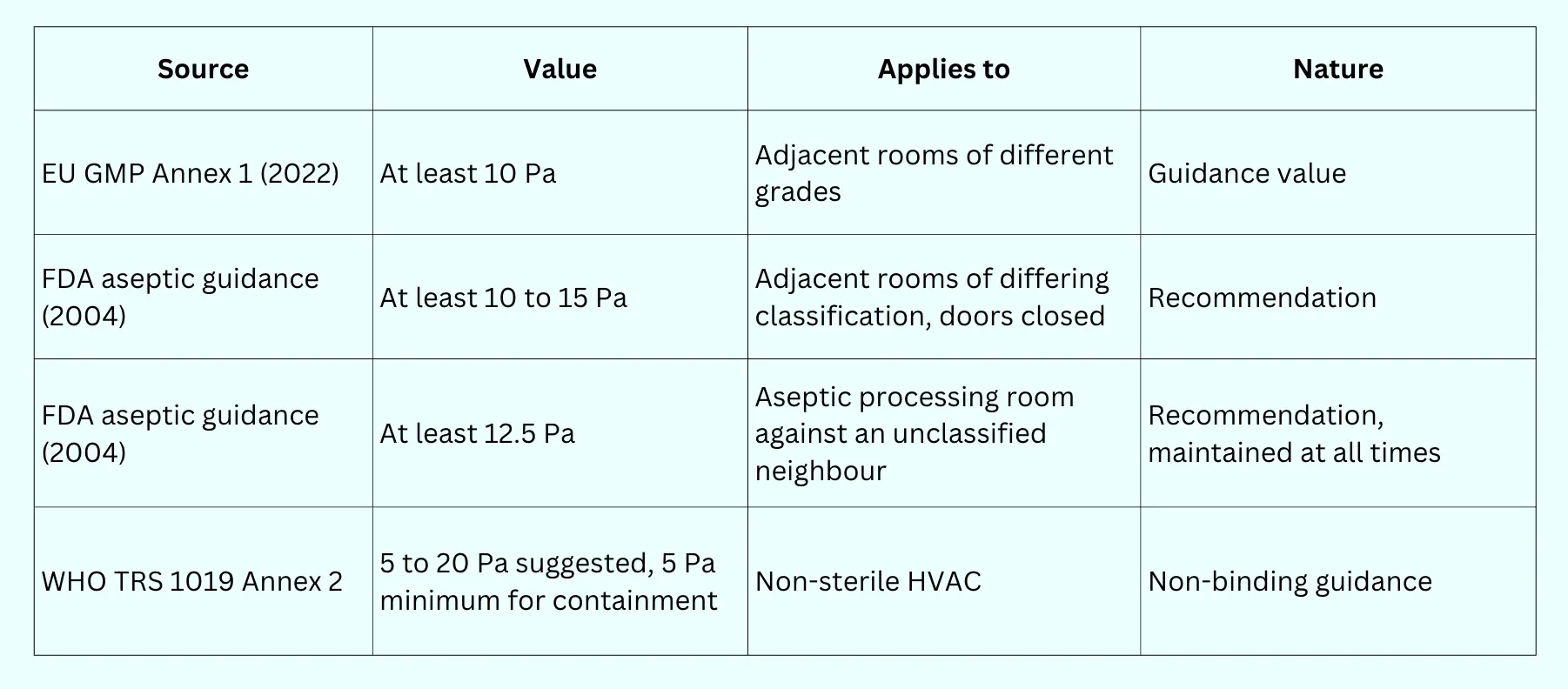
The 10 to 15 Pa range quoted in most cleanroom specifications therefore comes from FDA, not from Annex 1, and FDA ties it to a wider set of pressure cascade and alarm expectations. Many sites use both documents together.
Why 10 Pa is a floor and not a design target
A room that is designed to exactly 10 Pa has no margin for filter loading, door movement or gauge tolerance. Filter loading works through the air handling unit, so a drift in room pressure often starts with duct static pressure and AHU performance. Many facilities design toward the upper end of the 10 to 15 Pa range so that normal drift still leaves the room above the minimum. That is a design choice, not a regulatory number.
WHO's HVAC interpretation guidance adds a useful rule: the operating ranges of adjacent rooms should not overlap, because overlapping ranges can reverse airflow even when each room is "in limits". The same guidance warns that the combined tolerance of the measuring instruments should not allow an undetected reversal.
What continuous monitoring has to show
FDA recommends that pressure differentials between cleanrooms be monitored continuously throughout each shift and frequently recorded, that all alarms be documented, and that deviations be investigated. If the differential between an aseptic room and an unclassified neighbour drops below the minimum, FDA says the room's environmental quality should be restored and confirmed. How long that recovery should take under Annex 1 is covered in the clean-up period explained. The underlying regulation, 21 CFR 211.42(c)(10)(iv), calls for a system for monitoring environmental conditions in aseptic processing.
A pressure alarm that coincides with an AHU fault usually shows up in temperature and humidity too, so the record has to support an excursion investigation, and the trends behind it are what an inspector asks for in environmental monitoring data.
Turning the requirement into a monitoring record
Ace Instruments cleanroom monitors assist users in complying with these expectations by providing continuous measurement, alarms, digitally stamped electronic records and an audit trail. The monitor does not itself make a room compliant. The room design, qualification and procedures do that, and the instrument supplies the evidence.
For the pressure point, the digital differential pressure gauge records the differential, and the RHT transmitter can log temperature and humidity on the same time base.
Ace Instruments has designed and manufactured process instrumentation in Hyderabad since 1991, exports to more than 26 countries, and holds ISO 9001:2015 certification, with CE marking on all products.
Frequently asked questions
1. What pressure differential does EU GMP Annex 1 require between cleanroom grades?
Annex 1 gives a guidance value of at least 10 Pa between adjacent rooms of different grades. It is a guidance value, so an alternative needs a documented, risk based justification.
2. Why do many cleanroom specifications say 10 to 15 Pa?
The 10 to 15 Pa range comes from FDA aseptic processing guidance, which recommends at least that between adjacent rooms of differing classification with doors closed. Annex 1 and FDA values are often applied together.
3. Does Annex 1 require continuous monitoring of pressure differentials?
Annex 1 expects pressure differences identified as critical to be continuously monitored and recorded, with a warning system for loss of differential. Other differentials should still be monitored and recorded at regular intervals.
4. Can alarm delays be used on cleanroom pressure alarms?
Yes. Where delays are set they should be assessed and justified, for example within the contamination control strategy, so that door movements do not cause nuisance alarms while genuine losses are still caught.
Why trust Cleanroom Monitors
Cleanroom monitoring instrumentation from Ace Instruments is CE marked and manufactured under an ISO 9001:2015 quality system at its Hyderabad facility, backed by more than 35 years of field experience and exports to more than 26 countries.
Stay updated
Know the latest trends in clean room solutions from the Ace Instruments team


