


Product Overview
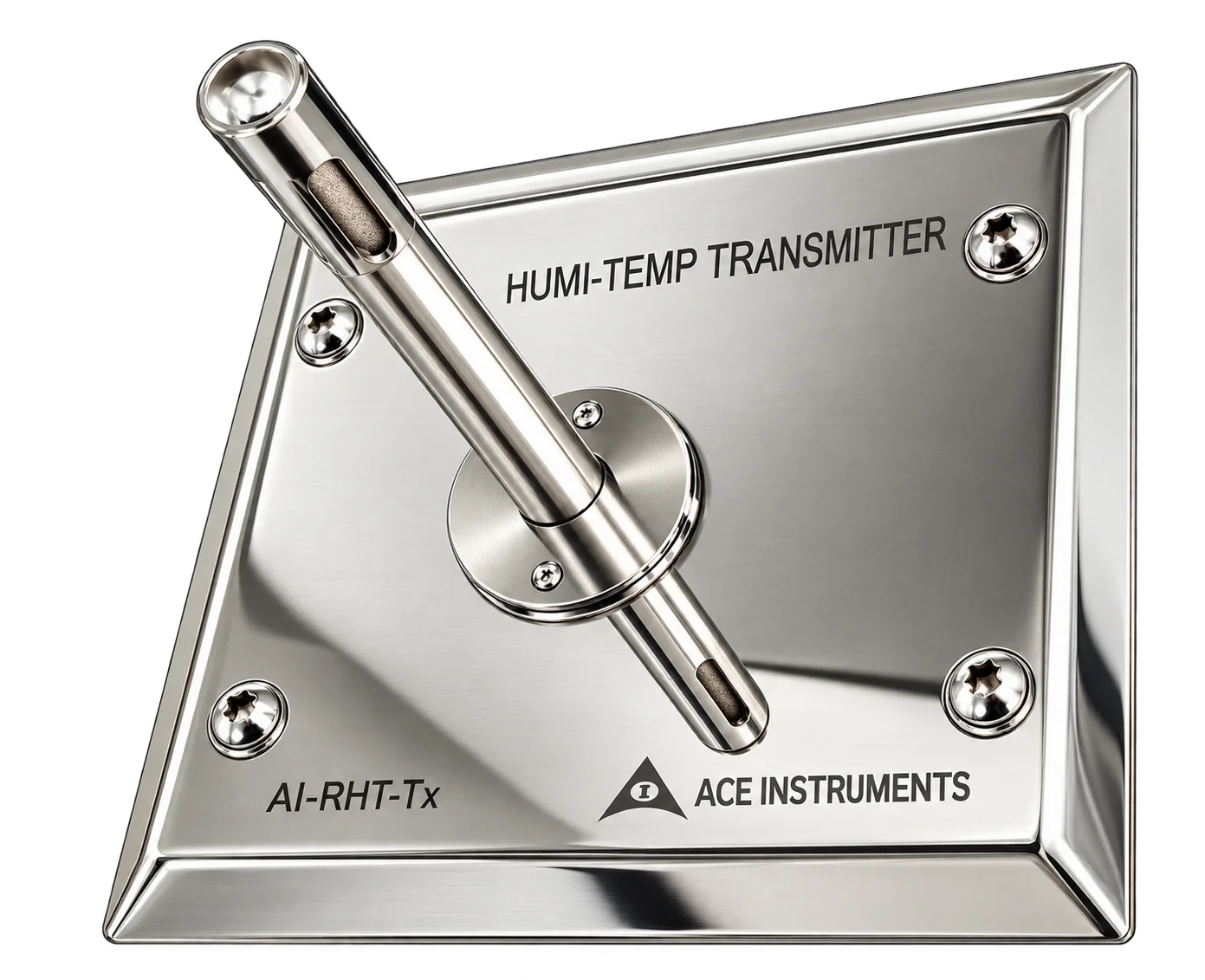
The AI-RHT-Tx is a cleanroom flush mount humidity and temperature transmitter. It sits in a stainless steel front flush plate that fits modular cleanroom wall panels, so the instrument adds no ledges or protrusions where particles can collect. Temperature and relative humidity are each sent as their own 4 to 20 mA signal, which can be wired to a BMS or to a display unit such as an Ace Instruments clean room scanner. Optional RS485 Modbus communication is available where a digital connection is preferred.
The transmitter is used for thermal mapping, temperature control in classified cleanroom areas, and other environments where temperature and humidity must be measured accurately and passed on to a control or recording system. These include solar, electronics, and semiconductor manufacturing.
How It Works
The transmitter uses polymer sensing for temperature and capacitive polymer sensing for relative humidity. The typical temperature range is -30.0 to +50.0°C, with other ranges customized to requirement, and the typical humidity range is 0.0 to 100.0% RH. Both readings are reported at a resolution of 0.1.
Each parameter has its own output. Temperature goes out on one 4 to 20 mA signal and humidity on another, so a BMS, PLC, or display unit can read each on a separate analog input. The transmitter has no local display. Readings are viewed on the connected display unit or on the BMS screen, and the instrument itself stays flush and unobtrusive in the wall. If the receiving system uses a digital network, the optional RS485 Modbus protocol sends both values over a single communication line.
The back box is 105 x 70 x 30 mm, so it fits shallow modular wall panels, and the front plate is 155 x 125 mm.
Features
- Flush Stainless Steel Front Plate:A smooth, cleanable surface that suits modular cleanroom wall panels.
- Two Independent 4 to 20 mA Outputs: One for temperature and one for relative humidity.
- Scanner Ready Outputs:
The 4 to 20 mA signals connect directly to the analog inputs of Ace Instruments cleanroom scanners, which show the readings and raise alarms. - Optional RS485 Modbus Communication: Digital integration with BMS and SCADA platforms.
- Polymer Temperature Sensing: Typical range of -30.0 to +50.0°C, with other ranges on request.
- Capacitive Polymer Humidity Sensing: Typical range of 0.0 to 100.0% RH.
- 0.1 Resolution: Fine resolution on both temperature and humidity.
- Compact 30 mm Back Box: Fits shallow wall cavities.
- 24 VDC Operation: 300 mA supply requirement.
- Powder Coated M.S. Back Box: Durable construction behind the flush stainless steel plate.
Applications
- Classified Cleanroom Areas:
Measures temperature and humidity in graded cleanrooms where conditions must stay inside defined limits, with the transmitter flush to the wall so it does not interrupt cleaning routines or airflow. - Thermal Mapping Studies:
Provides continuous temperature and humidity signals that a data logger or BMS records during mapping of cleanrooms, storage rooms, and controlled areas. - Temperature Control Loops:
Supplies the measured value that a controller or BMS uses to regulate HVAC systems serving a cleanroom. - Pharmaceutical Manufacturing:
Supports environmental monitoring in production, filling, and packaging areas where documented conditions are part of batch records. - Solar Manufacturing:
Monitors temperature and humidity in module assembly, lamination, and storage areas where moisture and heat affect process quality. - Electronics Manufacturing:
Tracks conditions in assembly and test areas where humidity influences soldering quality, component storage, and static control. - Semiconductor Facilities:
Provides temperature and humidity signals for fab and back end areas where tight environmental stability is part of process control.
Thermal Mapping and Temperature Control
Thermal mapping records how temperature and humidity are distributed across a space, so hot spots, cold spots, and areas that drift from the setpoint can be identified. The AI-RHT-Tx supports this work by delivering continuous signals to whatever system is recording them. Several transmitters placed at different positions can feed a multichannel data logger or a BMS, and the resulting data shows how conditions vary across the room and over time.
For control, the same signals serve as the feedback value for the HVAC system. When temperature or humidity moves away from its setpoint, the controller reads the transmitter output and corrects it.
The transmitter's accuracy is ±0.5°C for temperature and ±1.8% RH from 10 to 95% RH. Before using it in a formal mapping protocol, check these figures against the accuracy that your protocol requires, since some qualification studies call for calibrated reference sensors with tighter tolerances.
Display Unit or BMS: Choosing the Receiving System
The two 4 to 20 mA outputs let you choose how readings are viewed and recorded:
- BMS or PLC:
Wire each output to an analog input. This suits facilities that already monitor and trend cleanroom conditions centrally. - Display Unit:
Wire the outputs to a display such as an Ace Instruments clean room scanner, which accepts 4 to 20 mA inputs and shows readings locally with alarms. This suits rooms where operators need to see conditions at a glance. - Both:
A signal split or a second receiving device can serve a local display and a central system together. Confirm the wiring arrangement with our technical team. - RS485 Modbus (optional):
Choose this when the receiving system communicates digitally and a single communication line is preferred over separate analog wiring.
Connecting the AI-RHT-Tx to a Cleanroom Scanner
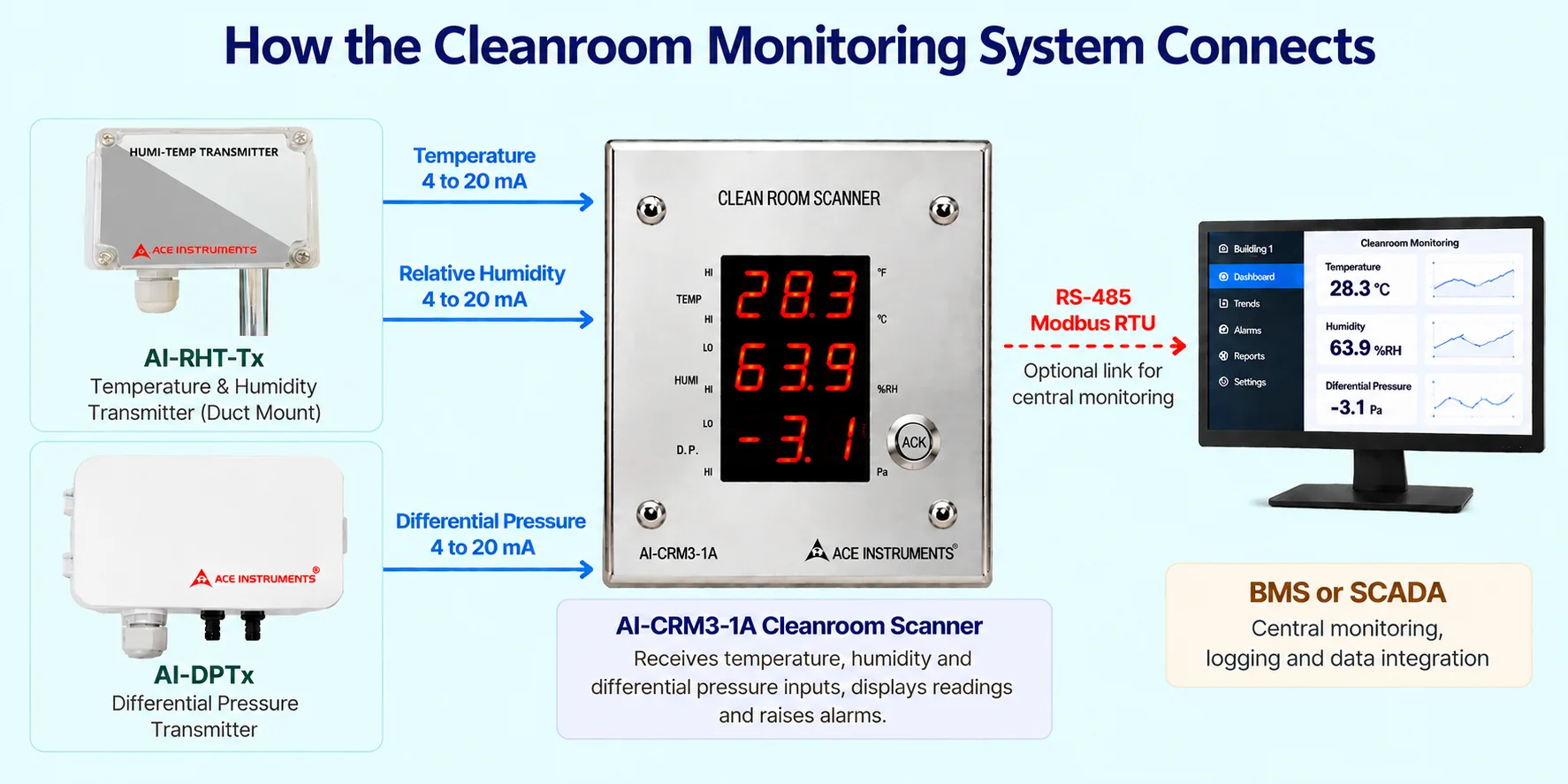
The AI-RHT-Tx has no display of its own, so many rooms pair it with an Ace Instruments cleanroom scanner. The transmitter sends temperature and humidity as two separate 4 to 20 mA signals, and the scanner turns them into a live local reading with alarms. The scanner is the part people see, and the transmitter is the part that stays flush in the wall.
Example: Temperature, Humidity, and Pressure on One Scanner
The Clean Room Smart Process Scanner (AI-CRM3-1A) has three analog inputs, and each one accepts 4 to 20 mA or 0 to 10 VDC. That gives a simple three parameter setup:
- Input 1: The AI-RHT-Tx temperature output
- Input 2: The AI-RHT-Tx humidity output
- Input 3: A differential pressure transmitter for the room
The scanner shows all three readings on its three line, 0.8 inch LED display. If any of them leaves its limit, the integrated buzzer sounds, and an individual LED shows which parameter caused it. Staff acknowledge the alarm with the front key. If a BMS or SCADA system should also see the readings, the scanner offers optional isolated RS485 Modbus RTU communication.
Setting Up the Scanner for the Transmitter
- Select the input type. Set each input you use to 4 to 20 mA. On the scanner this is done with the field jumper for that channel.
- Match the range to the transmitter. Program the scanner range for each channel so it agrees with the transmitter range.
For example, if the transmitter is set to -30.0 to +50.0°C, the scanner temperature channel is programmed over the same span, and the humidity channel over 0.0 to 100.0% RH. The scanner range is programmable from -199 to 999 with a selectable decimal point, so the display reads in real units. - Set the alarm limits. Enter the high and low limits that your cleanroom protocol defines for each parameter. The buzzer delay can be programmed, so a brief excursion, such as a door opening, does not sound an immediate alarm.
- Apply an offset if needed. The scanner has a password protected offset for correcting a known sensor error. Record any offset you apply in your documentation.
- Add Modbus if you need it. Choose the optional RS485 Modbus RTU output when a BMS or SCADA system should also collect the readings.
Other Scanner Options
Clean Room Smart Process Scanner (AI-CRM3-1A): You want a straightforward three input LED display with alarms.
Clean Room Scanner with Real Time Clock (RTC) : You also want a time reference for alarms and records, with a clock that can be synchronized to ACE Time Sync Software.
Both accept 4 to 20 mA and 0 to 10 VDC inputs and have three channels. Ask our team which one suits your project.
Wiring and Power
The AI-RHT-Tx runs on 24 VDC at 300 mA, and the AI-CRM3-1A runs on 24 VDC at 500 mA. When both share a supply, size it for the combined load of every device on it. Our technical team will confirm the wiring arrangement for the scanner you choose, including how the loop is powered, before installation.
Specifications
{{table-component}}
Compliance
Cleanrooms are expected to demonstrate that temperature and humidity stay within defined limits, and the evidence usually comes from continuous monitoring. The AI-RHT-Tx supplies the measurement signal for that record. The compliance controls themselves, such as audit trails, electronic signatures, and access control under 21 CFR Part 11, sit in the system that receives and stores the data, whether that is a BMS, SCADA, or data logger.
For facilities working under ISO 14644 classification requirements, EU GMP Annex 1, or similar frameworks, the transmitter gives a dependable input to the monitoring system, with the specific limits and alarm strategy defined by the facility's own contamination control and qualification documents. Ace Instruments manufactures under ISO 9001:2015 certified processes. If your validation plan requires calibration certificates, request them when you place the order.
Frequently Asked Questions
1. What is AI-RHT-Tx?
The AI-RHT-Tx is a flush mount temperature and humidity transmitter for cleanrooms. It measures both parameters and sends each as a separate 4 to 20 mA signal to a BMS, PLC, or display unit.
2. What does flush mount mean for a cleanroom transmitter?
The transmitter sits in a stainless steel front plate that is flush with the wall surface. This avoids protruding housings that collect particles and makes the wall easier to clean, which is why flush mounting is common in modular cleanroom panels.
3. What temperature and humidity ranges can it measure?
The typical temperature range is -30.0 to +50.0°C, and other temperature ranges can be customized. The typical humidity range is 0.0 to 100.0% RH.
4. How accurate is the AI-RHT-Tx?
Temperature accuracy is ±0.5°C. Humidity accuracy is ±1.8% RH from 10 to 95% RH and ±3% RH for all other ranges. Resolution is 0.1°C for temperature and 0.1% RH for humidity.
5. What outputs does the transmitter provide?
It provides two 4 to 20 mA outputs, one for temperature and one for humidity. RS485 Modbus communication is available as an option.
6. Does the transmitter have a display?
No. The transmitter has no local display. Readings are viewed on a connected display unit or on the BMS screen.
7. Can I connect it to a display unit?
Yes. The 4 to 20 mA outputs can be connected to a compatible display unit, such as an Ace Instruments clean room scanner, which shows the readings locally and can raise alarms when limits are exceeded.
8. Can the AI-RHT-Tx be connected to an Ace Instruments scanner?
Yes. The two 4 to 20 mA outputs connect to two analog inputs of a compatible Ace Instruments cleanroom scanner, such as the Clean Room Smart Process Scanner (AI-CRM3-1A) or the Clean Room Scanner with RTC. The scanner then shows the readings locally and raises alarms.
9. Which scanner inputs does the transmitter use?
It uses two inputs, one for temperature and one for humidity. A three input scanner has a third input free for another signal, such as a differential pressure transmitter.
10. Can one scanner show temperature, humidity, and pressure together?
Yes. Connect the AI-RHT-Tx to two inputs and a differential pressure transmitter to the third. All three readings appear on the scanner display, each with its own alarm.
11. What range should I set on the scanner?
Set each channel to the same range as the transmitter output. For a transmitter set to -30.0 to +50.0°C and 0.0 to 100.0% RH, program the scanner temperature channel across that temperature span and the humidity channel across 0.0 to 100.0% RH.
12. Can the scanner also send the readings to a BMS?
Yes. The scanner has an optional isolated RS485 Modbus RTU output that sends the displayed values to a BMS or SCADA system.
13. Can it be integrated with a BMS?
Yes. Wire the two 4 to 20 mA outputs to analog inputs on the BMS or PLC, or choose the optional RS485 Modbus version if your BMS communicates digitally.
14. Is it suitable for thermal mapping?
It can supply continuous temperature and humidity signals to a data logger or BMS during a mapping study, with several transmitters placed across the space. Check its ±0.5°C temperature accuracy against your mapping protocol, since some protocols require calibrated reference sensors with tighter tolerances.
15. Can it be used for temperature control?
Yes. The 4 to 20 mA temperature signal can serve as the feedback value for a controller or BMS regulating the HVAC system that serves the cleanroom.
16. Which industries use this transmitter?
It is used in pharmaceutical cleanrooms and in solar, electronics, and semiconductor manufacturing, along with other controlled environments that need temperature and humidity signals sent to a control or monitoring system.
17. What power supply does it need?
The transmitter operates on 24 VDC with a supply current of 300 mA.
18. How deep is the installation?
The instrument back box measures 105 x 70 x 30 mm, and the stainless steel front plate measures 155 x 125 mm. The 30 mm depth suits shallow modular wall panels.
19. Does it meet 21 CFR Part 11 or ISO 14644 requirements?
The transmitter provides the measurement signal. Part 11 controls such as audit trails and electronic signatures belong to the system that records the data, and ISO 14644 limits and alarm strategy are defined by the facility's own documents. The transmitter is a dependable input to a monitoring system working under those frameworks.
20. Does it need calibration?
Periodic calibration is good practice for any instrument used in a regulated environment. The interval depends on your quality system and the criticality of the measurement. Contact Ace Instruments for calibration support and certificate requirements.
21. How do I choose between the AI-RHT-Tx and a full cleanroom monitor?
Choose the transmitter when you want a discreet flush sensing point that sends signals to a BMS or an existing display. Choose a monitor or scanner with a built in display when operators need to read conditions and receive alarms directly at the wall.
22. What should I provide when ordering?
Tell us the required temperature range, whether you need the RS485 Modbus option, the receiving system (BMS, PLC, or display unit), the wall panel type, and any calibration documentation you need.
Gain insight into your IAQ solution and know technical specifications