
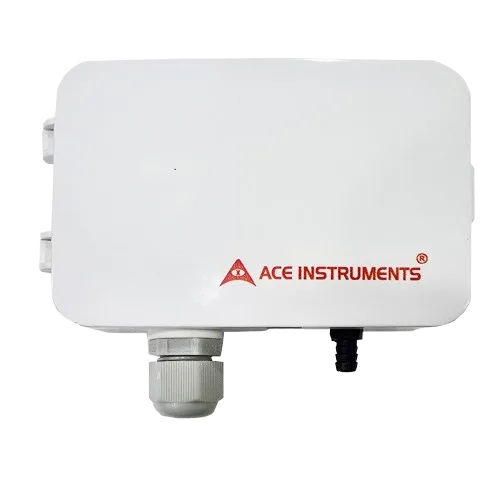
Duct Static Pressure Transmitter (AI-DP-S)
See how hard your duct is working. A compact transmitter that turns duct static pressure into a 4 to 20 mA or 0 to 10 VDC signal, with the probe and tubing already in the box and a calibration certificate with every unit.
 Static Pressure
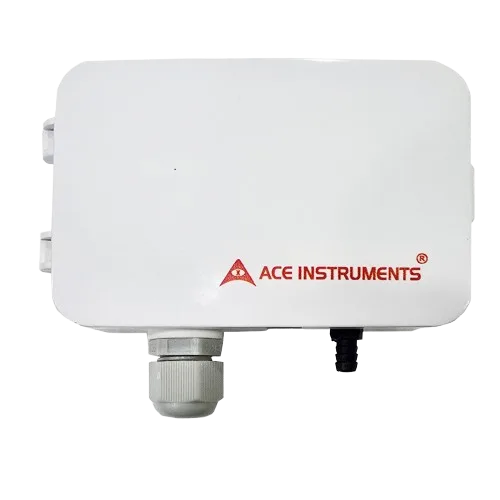
A direct measure of the resistance your air is meeting
The AI-DP-S measures the static pressure inside an HVAC duct, which is a direct measure of the resistance the air is meeting. It sends the reading as a standard analog signal, so your BMS, PLC, or HVAC controller can see it and act on it. The transmitter sits on the wall, and a probe inside the duct connects to it by tubing, so the electronics never go into the airstream.
It is made for commercial and residential buildings, hospitals, cleanrooms, and VAV systems, wherever the air distribution system needs to be kept efficient. The standard range is 0 to 400 Pa, and other ranges can be supplied on request.
Sense, convert, signal
A static pressure probe is fitted inside the duct, and silicon tubing carries the pressure from the probe to the transmitter, which is mounted nearby on the wall. The transmitter measures it with ±0.5% of full scale accuracy and converts it to an output signal. A jumper sets the output to 4 to 20 mA or 0 to 10 VDC. The signal goes to your control system, which uses it to monitor the duct and, if you wish, to adjust fan speed or dampers.
One transmitter, two signals
Set the jumper to match the input on your controller before you install the transmitter. The same pressure reading leaves the transmitter as either a current or a voltage signal.
The AI-DP-S sends the signal to your controller. The reading is shown by the system that receives it.
Built for duct pressure monitoring
Real Time Air Resistance Reading
Shows how much pressure the duct is carrying
Probe and Tubing in the Box
A static pressure probe and 2 m of silicon tubing come as standard
Jumper Selectable Output
4 to 20 mA or 0 to 10 VDC
±0.5% of Full Scale Accuracy
Dependable readings for duct monitoring and airflow work
Standard 0 to 400 Pa Range
With other ranges available by request
Strong Overpressure Tolerance
±10,000 Pa
Factory Calibrated
A calibration certificate with every transmitter
Compact ABS Enclosure
100 x 70 x 30 mm, mounts on the wall near the duct
CE Marked
The datasheet carries the CE mark
Where the AI-DP-S is used
Hospitals
Tracks duct static pressure in the air distribution that serves wards, theatres, and isolation rooms, so the ventilation system keeps delivering the airflow those spaces need
Cleanrooms
Watches the static pressure in supply ducts feeding a cleanroom, which shows when a filter loads or a damper moves before the room feels it
Commercial Buildings
Gives the building system the duct pressure it needs to optimize fan energy and airflow
Residential Buildings
Supports ventilation systems that rely on a steady duct pressure
Variable Air Volume (VAV) Systems
Supplies the duct static pressure that a VAV system uses to control fan speed as terminal dampers open and close
Air Distribution and Ventilation Installations
Measures duct pressure wherever the resistance to airflow needs to be known
Choose the transmitter that answers your question
Static pressure is the pressure of the air inside a duct. Differential pressure is the difference between two points, such as the two sides of a filter or a room and its corridor.
| What you need to know | AI-DP-S (static pressure) | Differential pressure transmitter (such as AI-DPTx) |
|---|---|---|
| What it measures | The pressure of the air inside a duct | The difference between two points |
| Typical measuring points | A probe inside the duct | Across a filter, or between a room and its corridor |
| Use it when | You want to know the duct's static pressure, for example to control a fan | You want the difference between two places |
Many HVAC systems use both.
Choosing the Range
The standard range is 0 to 400 Pa. If your duct runs at a different pressure, share the expected operating pressure with our team, and we will confirm a range for you. A range that suits the real pressure gives the finest reading.
Choosing the Output
4 to 20 mA: Suits most BMS and PLC analog inputs, and is the usual choice for longer cable runs.
0 to 10 VDC: Suits controllers that expect a voltage signal.
Set the jumper to match the input on your controller before you install the transmitter.
From duct to controller in five steps
Fit the probe
Install the static pressure probe in the duct, in the position the system design calls for.
Mount the transmitter
Fix the enclosure to a wall near the duct. It is 100 x 70 x 30 mm.
Connect the tubing
Connect the silicon tubing from the probe to the transmitter. The tubing is 2 m long as standard.
Set the output
Set the jumper to 4 to 20 mA or 0 to 10 VDC.
Wire it
Connect 24 VDC power and the output to your controller.
Everything for the duct and the wall
- The transmitter, in an ABS enclosure
- A static pressure probe for the duct
- 2 m of silicon tubing, standard
- A calibration certificate, one for each transmitter
Light upkeep
Each transmitter is factory calibrated and supplied with its own certificate. Check the probe, the tubing, and the connections on a regular schedule, because a kinked or loose tube gives a false reading. Verify the transmitter against a reference on the schedule your quality system sets.
Technical specifications
Supports controlled and efficient air systems
Duct static pressure is part of how an HVAC system is controlled and kept efficient, including systems serving cleanrooms and hospitals. The AI-DP-S assists users with that work by providing a measurement signal for a BMS, PLC, or controller. It does not store records or raise alarms by itself, and it does not replace your commissioning and validation work.
CE marked, made under ISO 9001:2015
The datasheet carries the CE mark, and Ace Instruments manufactures under an ISO 9001:2015 certified quality management system.
Frequently asked questions
1. What is the AI-DP-S Duct Static Pressure Transmitter?
The AI-DP-S is a duct static pressure transmitter designed to measure air pressure inside HVAC ducts. It converts the measured pressure into an electrical signal that can be used by building automation and HVAC control systems to monitor airflow conditions.
2. Why is duct static pressure monitoring important in HVAC systems?
Duct static pressure provides information about the resistance and pressure conditions within an air distribution system. Monitoring it helps HVAC operators understand system performance, assess airflow conditions, and make appropriate adjustments to maintain efficient operation.
3. How does the AI-DP-S measure static pressure inside an air duct?
The AI-DP-S uses a static pressure probe connected to the transmitter through silicon tubing. The probe is installed inside the duct to sense static pressure, which is transmitted to the instrument for measurement and conversion into an output signal.
4. What is the standard measuring range of the AI-DP-S?
The standard measurement range is 0 to 400 Pa. Other pressure ranges can also be customized according to application requirements. Customers can discuss their required range with the technical team before ordering.
5. Can the measuring range be customized?
Yes. The AI-DP-S supports customized measurement ranges based on user requirements. If your HVAC application requires a range other than 0 to 400 Pa, you can share the required operating pressure with the technical team for confirmation.
6. What output signals are available with the AI-DP-S?
The transmitter supports two analog output options, 4 to 20 mA and 0 to 10 VDC. The output can be selected using the jumper configuration, allowing the transmitter to work with compatible HVAC controllers and monitoring systems.
7. Can the AI-DP-S be connected to a Building Management System (BMS)?
Yes. The 4 to 20 mA or 0 to 10 VDC output can be connected to compatible BMS controllers, PLCs, and HVAC automation systems. This allows duct static pressure readings to be monitored through the connected control system.
8. How accurate is the AI-DP-S transmitter?
The AI-DP-S has a specified measurement accuracy of ±0.5% of full scale. This allows it to provide pressure measurements for HVAC duct monitoring and airflow related applications.
9. What accessories are supplied with the AI-DP-S?
The standard accessories include 2 metres of silicon tubing and a static pressure probe for duct installation. These accessories help connect the transmitter to the duct pressure measurement point.
10. What is the purpose of the static pressure probe?
The static pressure probe is installed inside the HVAC duct to sense static air pressure. It connects to the transmitter through silicon tubing, allowing the instrument to measure duct pressure without placing the transmitter itself inside the duct.
11. Where can the AI-DP-S be used?
The AI-DP-S is suitable for applications where duct static pressure needs to be monitored, including commercial HVAC systems, residential building ventilation systems, hospitals, pharmaceutical cleanrooms, Variable Air Volume (VAV) systems, and air distribution and ventilation installations.
12. What power supply does the AI-DP-S require?
The transmitter operates on a 24 VDC power supply with a specified current requirement of 200 mA. Ensure that the power supply and electrical connections meet the product requirements.
13. What type of enclosure is used in the AI-DP-S?
The transmitter comes in an ABS plastic enclosure designed for wall mounting. Its compact dimensions are 100 mm (W) x 70 mm (H) x 30 mm (D), making it convenient to install near the duct measurement location.
14. Can the AI-DP-S be installed directly on an HVAC duct?
The transmitter is designed for wall mounting, while the supplied static pressure probe is installed in the duct. Silicon tubing connects the probe to the transmitter. This arrangement allows the pressure measurement point and transmitter enclosure to be positioned separately.
15. What is the maximum overpressure capacity of the AI-DP-S?
The specified maximum overpressure capacity is ±10,000 Pascals. This indicates the pressure tolerance stated in the product specifications and should not be confused with the normal measurement range of 0 to 400 Pa.
16. Is the AI-DP-S supplied with a calibration certificate?
Yes. Each transmitter is factory calibrated and supplied with an individual calibration certificate. This provides customers with calibration documentation for their instrument.
17. What should be considered when selecting the right AI-DP-S configuration?
Before ordering, consider the expected duct static pressure, required measurement range, preferred output signal (4 to 20 mA or 0 to 10 VDC), power supply availability, and compatibility with the existing HVAC or BMS controller. These details help identify the appropriate configuration.
18. Does the AI-DP-S have a display?
The AI-DP-S is a transmitter, and its datasheet lists no display. The reading is shown by the system that receives the signal, such as a BMS, a PLC, or a cleanroom scanner.
19. What is the difference between the AI-DP-S and a differential pressure transmitter?
The AI-DP-S measures static pressure inside a duct. A differential pressure transmitter, such as the AI-DPTx, measures the difference between two points, for example across a filter or between a room and its corridor. Use the one that matches what you need to know.
20. How can I request a quotation or technical assistance for the AI-DP-S?
For product specifications, customized pressure ranges, output selection, installation guidance, or pricing, contact the Cleanroom Monitors team through the contact page. You can share your application details and required output signal so the technical team can assist with selecting the suitable transmitter configuration.
Need help choosing?
Tell us your duct pressure, output signal, and controller and our application engineers will confirm the right AI-DP-S for you.
Exceptional Instruments That Surpass Your Technical Expectations
Powerful, customized solutions to suit your unique cleanroom monitoring needs
Discover moreGain insight into your IAQ solution and know technical specifications