
.webp)
.webp)
Product Overview
Hospital facility teams and infection-control staff depend on the correct ventilation rate in operating theatres, isolation rooms and other controlled patient areas. That rate can drift silently between scheduled inspections. The AI-CRS1-TFT gives facility managers and HVAC engineers a continuous Air Changes per Hour (ACH) reading at the room itself, so ventilation deviations are caught as they happen instead of at the next routine audit. The same continuous verification also applies to pharmaceutical cleanrooms and support areas, where air change rates must be defined, qualified and monitored.
How It Works
An external ACH transmitter in the ventilation duct continuously measures air velocity. The connected touchscreen display calculates the resulting air change rate for the room and shows it. Facility staff and infection-control teams can check the display at any time and see the current ventilation status, instead of relying on periodic manual tests that confirm performance only at a single moment. When the measured ACH moves outside its configured limits, the monitor sounds a local alarm so engineering teams can investigate before the deviation becomes a larger operational or compliance problem.
Why This Matters for Infection Control
Maintaining the required ventilation rate is a recognised part of environmental control in healthcare spaces. This is especially true in operating theatres and isolation rooms, where air exchange directly affects contamination risk. Continuous ACH visibility tells infection-control and facility teams that a room is performing as designed, and warns them early when it isn't. To be clear about scope, the monitor is a measurement and alerting device that flags changes in ventilation performance. The room's actual ACH requirement, and whether the room meets a specific infection-control standard, should be set through the project's design specification and applicable healthcare guidelines.
Features
- Continuous ACH Visibility:
The local touchscreen shows the real-time air change rate, with no waiting for the next scheduled test.
- High & Low Limit Alarms:
A built-in buzzer alerts facility staff as soon as ventilation performance moves outside configured limits.
- Alarm Acknowledgement Key:
Lets staff confirm they have seen an alert and are acting on it.
- Centralised Monitoring via BMS/EMS/SCADA:
RS-485 Modbus RTU communication brings ACH data into the hospital's existing building management infrastructure.
- Optional 4-20mA Retransmission:
Analog output for integration with compatible monitoring or control equipment.
- Programmable Measurement Range:
Configurable from 0 to 500 ACH to match the specific room and duct arrangement.
- Discreet Flush-Mounted Installation:
Stainless steel front plate suited to modular hospital wall panels or brick walls.
Applications
- Operating Theatres:
Continuous ventilation checks support the strict air exchange requirements that surgical environments depend on.
- Isolation Rooms:
Ongoing ACH visibility supports containment, where controlling air movement is part of patient and staff safety.
- Treatment Rooms:
Monitors ventilation in clinical spaces where consistent air exchange affects both comfort and infection risk.
- Controlled Patient Areas:
Suits any HVAC-controlled hospital space where facility teams need constant visibility of ventilation, not just periodic confirmation.
- Pharmaceutical Cleanrooms and Support Areas:
Gives continuous evidence that qualified air change rates are being maintained in graded areas, supporting the contamination control strategy between requalification tests.
Choosing the Right Model
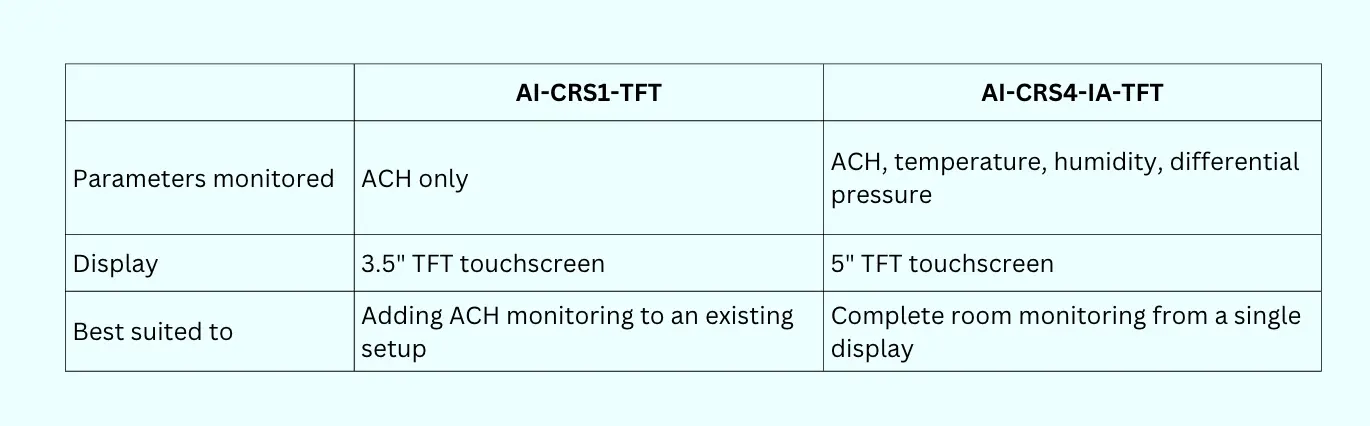
Monitoring ACH only? Choose the AI-CRS1-TFT
The AI-CRS1-TFT is a dedicated single-parameter monitor built for continuous ACH monitoring. It is the right choice when:
- Ventilation rate is the specific gap in your current monitoring setup.
- Temperature, humidity and differential pressure are already monitored by separate systems.
- You want a compact 3.5-inch display focused entirely on air change rate.
Need ACH plus other parameters? Choose the AI-CRS4-IA-TFT
The AI-CRS4-IA-TFT shows ACH together with temperature, humidity and differential pressure on a single 5-inch touchscreen. It is the right choice when:
- You are specifying monitoring for a new operating theatre, isolation room or cleanroom from scratch.
- You want one complete environmental picture instead of separate instruments for each parameter.
- Room pressure cascades and temperature and humidity limits must be verified alongside ventilation rate.
If you are unsure which model fits your project, Our engineering team can review your room requirements and recommend the right configuration.
Supporting HVAC Troubleshooting
An unexpected drop in ACH is often the first visible sign of an underlying HVAC issue. The cause may be reduced airflow, a loading filter, a fan losing performance, a damper that has shifted, or a duct obstruction. These problems don't always show up any other way. A continuously monitored ACH trend prompts engineering teams to investigate early, instead of waiting for the next scheduled airflow test to catch the issue. For consultants and HVAC teams managing many hospital rooms, ventilation maintenance becomes something they act on as deviations occur, not a reactive task tied to the calendar.
Supporting Hospital Ventilation Commissioning
Ventilation commissioning is where a project confirms that a room's HVAC system actually delivers its design air change rate before the space goes into clinical use. The AI-CRS1-TFT supports this by giving commissioning teams a continuous real-time ACH reading on site during testing and balancing. That is more than a handheld anemometer can give with a single reading at one point in time.
After commissioning, the same monitor stays in place. The instrument that helped validate the room's ventilation becomes an ongoing verification tool, instead of a one-time device removed after acceptance testing is signed off. For consultants on multi-room hospital projects, this simplifies the handover from commissioning to operational monitoring. Engineers use the touchscreen during testing and balancing, and facility staff read the same display every day afterwards.
As with any commissioning activity, the project's design consultant and the applicable healthcare standards should define the final acceptance criteria, target ACH values and validation procedures. The monitor supports this process with continuous visibility, but it does not set the acceptance criteria itself.
Specifications
{{table-component}}
Compliance
ACH is part of the environmental control criteria in hospital design standards for operating theatres, isolation rooms and other controlled clinical spaces. It is also part of the GMP framework for pharmaceutical cleanrooms. The AI-CRS1-TFT supports continuous verification against whatever ACH requirement the project design and applicable standards call for. The project's design consultant should always set the specific target range and alarm limits, which should not be assumed from the instrument alone.
Healthcare Ventilation Standards
- ASHRAE 170, Ventilation of Health Care Facilities:
Sets minimum total and outdoor air change rates for operating rooms, isolation rooms, treatment rooms and other hospital spaces. It is the main reference for many hospital HVAC designs worldwide.
- FGI Guidelines for Design and Construction:
Adopts ASHRAE 170 ventilation requirements for healthcare facility design and is widely referenced in US hospital projects.
- CDC Guidelines for Environmental Infection Control in Health-Care Facilities (2003):
Specifies at least 12 ACH for new or renovated airborne infection isolation rooms. Continuous monitoring shows that this rate is being held during occupancy.
- UK HTM 03-01, Specialised Ventilation for Healthcare Premises:
Defines ventilation requirements for operating suites and critical care areas in UK healthcare facilities.
- DIN 1946-4, Ventilation in Buildings and Rooms of Health Care:
The German standard for healthcare ventilation, covering operating rooms and other protected areas.
- Gulf Region Health Facility Guidelines:
The DHA Health Facility Guidelines (Dubai), Ministry of Health Saudi Arabia (MOH Saudi Arabia), Department of Health Abu Dhabi and Qatar MOPH requirements all reference ventilation rates for hospital room design, which supports demand for continuous ACH verification across GCC healthcare projects.
Pharmaceutical and Cleanroom Standards
- US FDA Guidance for Industry, Sterile Drug Products Produced by Aseptic Processing (2004):
States that at least 20 air changes per hour is typically acceptable for ISO 8 support areas, a figure often quoted during audits. Continuous ACH data gives documented evidence that this rate is maintained.
- WHO GMP for HVAC Systems (TRS 961 Annex 5, revised as TRS 1010 Annex 8):
Expects air change rates in pharmaceutical facilities to be defined, qualified and monitored. A permanently installed ACH monitor covers the monitoring requirement between qualification exercises.
- EU GMP Annex 1 (2022):
Requires air change rates to be justified and qualified as part of the contamination control strategy. Ongoing ACH data supports the evidence that qualified conditions are maintained in routine operation.
- ISO 14644-3, Cleanrooms and Associated Controlled Environments, Test Methods:
Defines the airflow test methods that ACH is calculated from. The AI-CRS1-TFT uses the same airflow and room volume relationship to show ACH continuously between formal tests.
RS-485 Modbus RTU communication lets ACH data be logged and integrated into a facility's BMS, EMS or SCADA system, supporting the ongoing recordkeeping expected in regulated healthcare and pharmaceutical environments.
Frequently Asked Questions
1. Why is Air Changes per Hour monitoring important in hospital rooms?
Air Changes per Hour (ACH) is a key indicator of ventilation performance. Continuous ACH monitoring shows hospital facility teams that the ventilation system is maintaining the required air replacement rate. It also reveals changes in performance before they become a larger operational issue.
2. Which hospital rooms can benefit from ACH monitoring?
ACH monitoring is useful wherever ventilation performance is critical, including operating theatres, isolation rooms, treatment rooms, controlled patient areas and other HVAC-controlled spaces. The appropriate ACH requirement should come from the project design and applicable healthcare requirements.
3. Which standards specify ACH for hospital rooms?
Common references include ASHRAE 170, the FGI Guidelines, CDC 2003 Environmental Infection Control guidance (12 ACH for isolation rooms), UK HTM 03-01 and Germany's DIN 1946-4. In the Gulf region, they include the DHA Health Facility Guidelines, DoH Abu Dhabi and Qatar MOPH requirements. The standard that applies depends on the project location and specification.
4. Can the AI-CRS1-TFT be used in pharmaceutical cleanrooms?
Yes. Pharmaceutical GMP frameworks expect air change rates to be defined, qualified and monitored. These include the US FDA aseptic processing guidance, WHO GMP for HVAC systems and EU GMP Annex 1. The AI-CRS1-TFT provides continuous ACH data between formal requalification tests carried out to ISO 14644-3.
5. What ACH does the FDA expect for ISO 8 areas?
The US FDA's 2004 aseptic processing guidance states that at least 20 air changes per hour is typically acceptable for ISO 8 support areas. The actual requirement for a facility should be justified in its own contamination control strategy and qualification documents.
6. How does the AI-CRS1-TFT help monitor hospital ventilation?
The AI-CRS1-TFT continuously receives the ACH measurement from its external ACH transmitter and shows the calculated air change rate on a touchscreen. Facility personnel get a local, always visible indication of ventilation performance.
7. What does an ACH reading tell a hospital facility manager?
An ACH reading shows how quickly the ventilation system is replacing the room air. Trending this value helps facility teams spot changes in ventilation performance and investigate possible HVAC problems.
8. Can ACH monitoring help identify HVAC problems?
Yes. An unexpected change in ACH can prompt investigation of problems such as reduced airflow, filter loading, fan performance issues, damper changes or other HVAC faults. The ACH monitor gives maintenance teams an additional operational indicator.
9. Why is continuous ACH monitoring better than checking airflow occasionally?
A periodic airflow test gives information only for the moment it is performed. Continuous ACH monitoring gives ongoing visibility, so changes can be noticed between scheduled inspections or maintenance activities.
10. Should I choose the AI-CRS1-TFT or the AI-CRS4-IA-TFT?
Choose the AI-CRS1-TFT if you only need to monitor ACH, for example where temperature, humidity and pressure are already covered by other systems. Choose the AI-CRS4-IA-TFT if you want ACH, temperature, humidity and differential pressure together on one 7-inch touchscreen. This is common for new operating theatres, isolation rooms and cleanrooms.
11. Can the AI-CRS1-TFT provide an alarm when ventilation performance changes?
Yes. The monitor has a built-in buzzer for high and low limit alarms. An acknowledgement key lets personnel silence the alarm once the condition has been identified.
12. How can an ACH alarm help hospital engineering teams?
An ACH alarm gives an immediate local warning when the measured air change rate crosses the configured limit. Engineering personnel can then investigate promptly instead of relying only on routine inspections.
13. Can ACH data be monitored centrally?
Yes. The AI-CRS1-TFT supports RS-485 Modbus RTU communication, so the ACH value can be integrated with BMS, EMS and SCADA systems. This enables central monitoring in addition to the local touchscreen display.
14. Can the AI-CRS1-TFT be connected to an existing hospital BMS?
Yes. Its RS-485 Modbus RTU communication lets the monitor connect to compatible BMS, EMS or SCADA infrastructure. Facility teams can then view ACH alongside other building and HVAC parameters.
15. Can the ACH value also be transmitted as an analogue signal?
Yes. An optional 4-20 mA analogue retransmission output is available where the ACH measurement must connect to compatible monitoring or control equipment.
16. How is the ACH transmitter installed?
The system uses an external ACH transmitter connected to the display unit. The transmitter is installed in the ventilation duct and provides the measurement the display uses to determine the room's air change rate.
17. Does room size affect ACH monitoring?
Yes. Room volume is a key factor in calculating air changes per hour. The measurement range can be programmed between 0 and 500 ACH depending on room size and duct size, so each installation should be configured for its specific room and ventilation arrangement.
18. Can the AI-CRS1-TFT be used during hospital ventilation commissioning?
Yes. It shows ACH continuously on site and can be useful as part of a broader ventilation monitoring and commissioning strategy. Final acceptance and required ACH values should follow the project's applicable healthcare standards, design specifications and validation procedures.
19. How can ACH monitoring support infection-control objectives?
Maintaining the required ventilation conditions is an important part of environmental control in healthcare spaces. Continuous ACH monitoring shows facility teams how ventilation is performing and highlights deviations that may need investigation. The monitor itself is a measurement and alerting device. It does not by itself establish whether a room meets a particular infection-control requirement.
20. Can the monitor be used for isolation-room applications?
Yes. ACH monitoring is useful in isolation rooms where air change performance must be observed continuously. The CDC 2003 guidelines specify at least 12 ACH for new or renovated airborne infection isolation rooms. The setpoint and alarm limits for each room should come from the room design and applicable healthcare requirements.
21. Is the AI-CRS1-TFT suitable for operating theatres?
Yes. The AI-CRS1-TFT can be used wherever a hospital room or controlled ventilation area needs continuous ACH monitoring. For an operating theatre project, confirm the required ACH range, airflow arrangement, installation position and alarm limits during system design.
22. What happens if the ACH value falls below the configured limit?
The built-in buzzer sounds when the reading drops below the configured low limit. The operator can silence it with the acknowledgement key while the facility team investigates the underlying ventilation problem.
23. What are the main benefits of installing an ACH monitor in a hospital?
The main benefits include:
- Continuous visibility of ventilation performance
- Local touchscreen indication
- High and low limit alarm notification
- Faster identification of ventilation deviations
- RS-485 Modbus integration with BMS, EMS and SCADA
- Optional 4-20 mA retransmission
- Programmable ACH measurement range
- Ongoing data to support healthcare and GMP recordkeeping
24. How do I select the right ACH monitoring solution for my hospital?
Consider room volume, ventilation arrangement, duct size, expected ACH range, transmitter location, required alarm limits and integration needs. For continuous ACH monitoring with a local touchscreen and optional BMS, EMS or SCADA integration, the AI-CRS1-TFT is a dedicated solution. If temperature, humidity and differential pressure also need monitoring, consider the AI-CRS4-IA-TFT.
Gain insight into your IAQ solution and know technical specifications