October 14, 2026
The USP 797 and USP 800 pressure requirements split compounding rooms into two opposite designs. Non-hazardous sterile compounding rooms are positive to their neighbours, so clean air flows out. Hazardous drug rooms are negative, so air flows in and the drug stays contained. Both are specified in inches of water column (in. w.c.), which makes the Pa equivalent worth keeping next to the number.
Which rooms are positive and which are negative
USP 797 was revised in November 2022 and became enforceable on 1 November 2023. For non-hazardous preparations the ISO 7 buffer room is held positive to the anteroom, and the anteroom positive to the general area outside.
USP 800 covers hazardous drugs. The hazardous drug compounding room is held negative, and its anteroom positive to the unclassified area outside and positive to the negative room. The pressure cascade is positive anteroom to negative compounding room, with the compounding room exhausted outside. The air handling that makes this work, with dedicated supply and exhaust, is covered in dedicated AHUs for potent and cytotoxic areas.
Pressure values at a glance
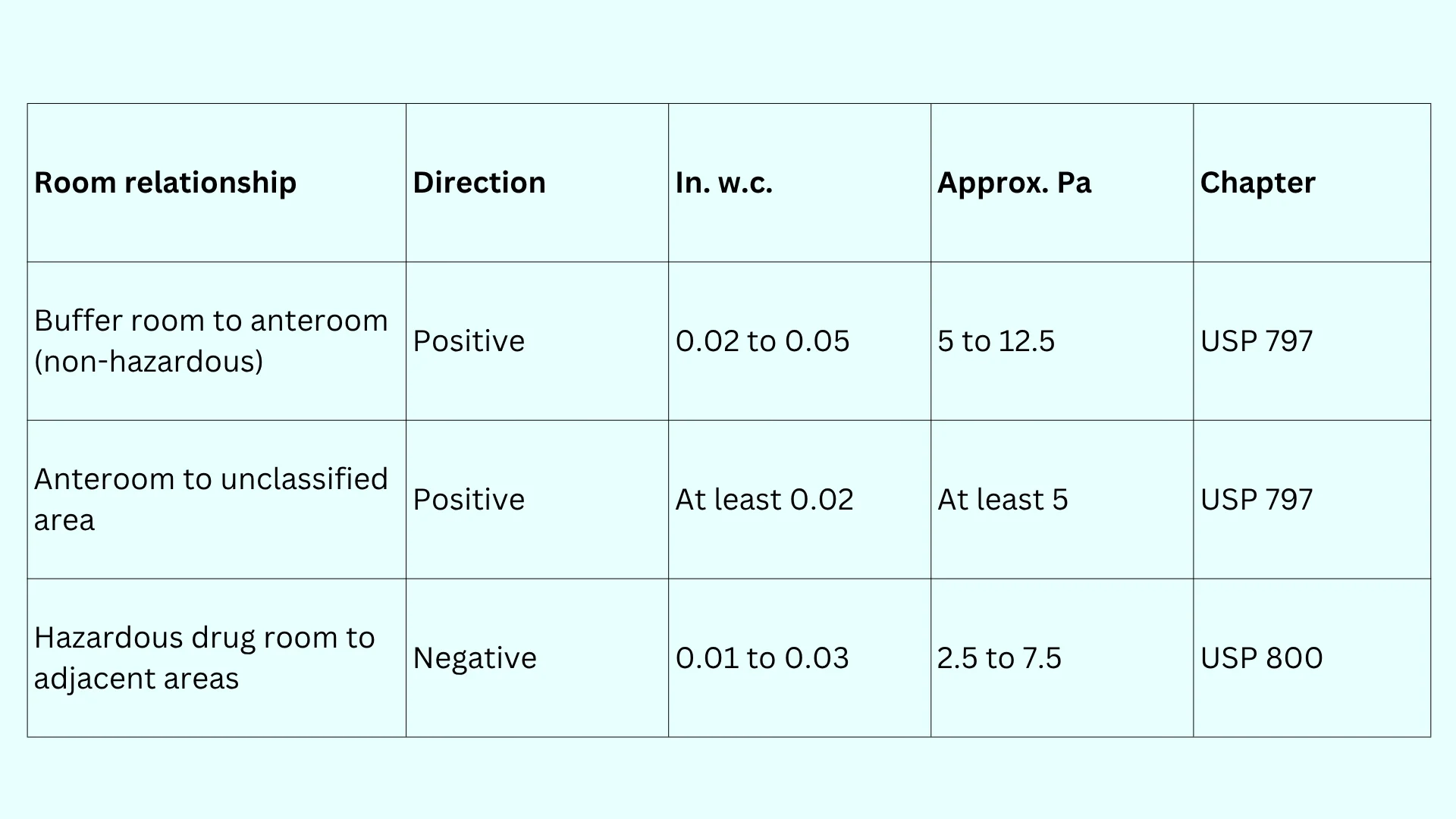
USP 800 states its negative pressure as a range, between 0.01 and 0.03 in. w.c. relative to adjacent areas, so the limit works in both directions: a room pulled too far negative is out of range just as one that is too weak. A state pharmacy board document reproducing the USP 800 text shows that wording for both sterile and non-sterile hazardous drug rooms, and industry design guidance adds that an anteroom serving a hazardous drug room must meet ISO 7 and 30 air changes per hour. Air change requirements for both chapters are covered in air change requirements for ISO 7 and ISO 8 rooms. The Pa column is a unit conversion of 1 in. w.c. to about 249 Pa.
Why the units matter for monitoring
A pharmacy cleanroom team reads in inches of water column, while a GMP plant reads in Pa, as in Annex 1 pressure differential requirements. A monitor with a clear display in the unit your SOP uses removes a common transcription error from daily logs. Where a room has a negative pressure hazardous drug side next to a positive anteroom, the reading should always carry a sign so the direction is unmistakable at the door. A band as narrow as 0.01 to 0.03 in. w.c. also raises the question of how long an alarm should wait when a door opens, which is covered in alarm delays and what inspectors look for.
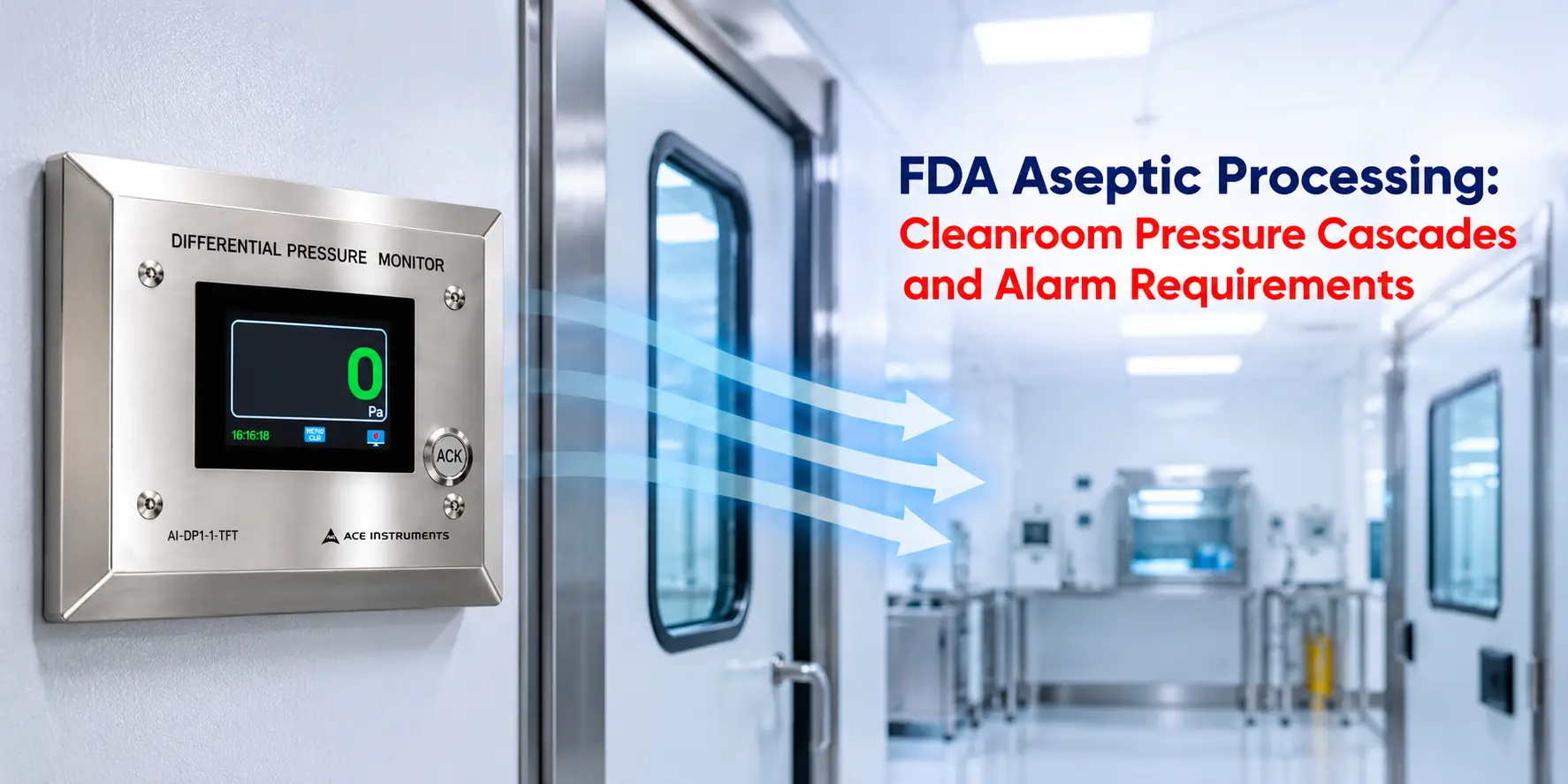
Pressure monitoring in compounding rooms is expected by the USP chapters, and a room pressure monitor with local display, alarm and an electronic record is the usual way to document it. Ace Instruments cleanroom monitors assist users in complying with USP 797 and USP 800 by providing monitoring, digitally stamped electronic records and an audit trail. The differential pressure monitor with colour TFT screen shows the reading at the door.
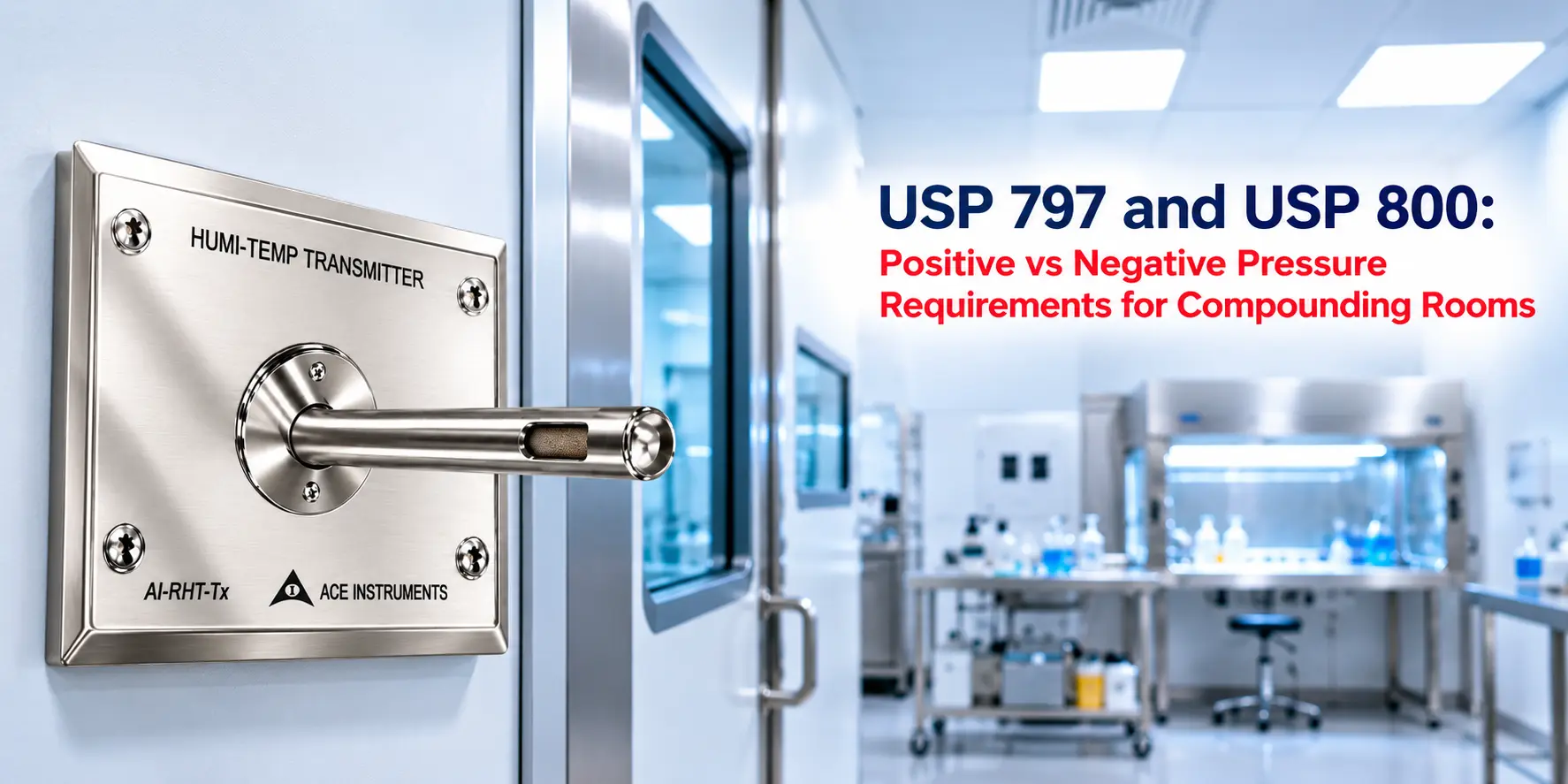
USP 797 also sets temperature limits for sterile compounding areas, covered in USP 797 temperature requirements, so it helps to log them beside pressure. The duct temperature transmitter and the RHT transmitter cover those points.
Ace Instruments, founded in 1991, is ISO 9001:2015 certified in Hyderabad, and all its products carry CE marking.
Frequently asked questions
1. Should USP 797 compounding rooms be positive or negative?
Non-hazardous sterile compounding rooms are held positive, with the buffer room positive to the anteroom and the anteroom positive to the general area. Hazardous drug compounding rooms under USP 800 are held negative.
2. What pressure differential does USP 797 specify?
Industry summaries of USP 797 give 0.02 to 0.05 in. w.c. (about 5 to 12.5 Pa) between the buffer room and anteroom, and at least 0.02 in. w.c. from the anteroom to the unclassified area.
3. What does USP 800 require for hazardous drug rooms?
USP 800 requires negative pressure of between 0.01 and 0.03 in. w.c. (about 2.5 to 7.5 Pa) relative to adjacent areas, so the room must be negative enough to contain the drug and not so negative that it falls out of range.
4. How should pressure be monitored in compounding rooms?
The USP chapters expect room pressure to be monitored. Most facilities use a room pressure monitor with a local display and alarm, plus a documented record, to show that each differential was maintained.
Why trust Cleanroom Monitors
Cleanroom monitoring instrumentation from Ace Instruments is CE marked and manufactured under ISO 9001:2015 in Hyderabad, with more than 35 years of field experience in process control instrumentation.
Stay updated
Know the latest trends in clean room solutions from the Ace Instruments team