November 10, 2026
BSL-3 lab directional airflow monitoring confirms that air moves into the laboratory from cleaner areas and keeps doing so if something fails. The CDC and NIH BMBL sets no single pressure value for it, so the evidence is a verified inward airflow, a visual indicator at the entry and a design whose airflow does not reverse under failure conditions.
This guide covers what the select agent program checks, how to monitor directional airflow between inspections, and why a pressure reading alone is not proof of direction.
What the BSL-3 guidance requires
The CDC and USDA select agent program's BSL-3 inspection checklist tests for a ducted ventilation system with airflow inward from clean to potentially contaminated areas, airflow that does not reverse under failure conditions, and a visual monitoring device that lets staff verify directional airflow. The program's verification process ties these to BMBL BSL-3 items D9 and D15, and lists the failure conditions to test: exhaust fan failure, simultaneous power failure of the supply and exhaust fans, and the return from a power failure to normal operation.
The annual verification policy asks the entity to document, initially and at least annually, that inward directional airflow was confirmed by observation. None of these documents gives a numeric pressure differential, so the set point is a site decision, and the aim is a differential that produces sufficient inward directional airflow.
Monitoring checks for directional airflow
Containment has to be sustained and not only present at commissioning, which is why continuous differential pressure monitoring with alarm notification is the usual design response. How long an alarm waits before it sounds is a documented decision, covered in alarm delays and what inspectors look for.
Positive readings are not the same as reversal
The select agent verification materials make a careful distinction: a positive pressure excursion is not necessarily an airflow reversal, and a repeat test with airflow observation settles whether reversal is occurring. A pressure log is therefore evidence but not proof on its own. The record should state the reference point for each reading, because a wrong reference can make a correctly negative room look positive.
A differential that drifts without a door event usually starts in the supply or exhaust, as described in duct static pressure and AHU performance.
Biosafety suites in GMP plants
Pharma and biologics sites with biosafety suites meet the same question from the GMP side. Annex 1 pressure differential requirements covers the positive pressure counterpart, and the air handling for containment areas is covered in dedicated AHUs for potent and cytotoxic areas.
Field note
Illustrative scenario: a BSL-3 suite's pressure log shows the differential rising from negative to slightly positive for several minutes when an exhaust fan trips. The team does not assume reversal. Airflow observation at the closed door shows air still moving inward, the event is recorded as an excursion with its reference point, and the exhaust interlock is reviewed. The continuous log and the dated observation record together close the event.
Frequently asked questions
1. What pressure differential does BMBL require for a BSL-3 laboratory?
BMBL does not set a single required value. The select agent program expects sustained inward directional airflow that does not reverse under failure conditions, with the set point chosen and verified by the laboratory.
2. How is directional airflow verified in a BSL-3 lab?
A visual monitoring device at the laboratory entry lets staff confirm direction, and inward airflow is confirmed by observation, for example with a smoke indicator at the door, initially and at least annually.
3. Is a positive pressure reading in a BSL-3 lab always an airflow reversal?
No. The select agent verification materials say a positive pressure excursion is not necessarily an airflow reversal, so airflow should be observed to settle it. It still warrants investigation.
4. Why should BSL-3 pressure be continuously monitored and alarmed?
Containment depends on inward airflow being sustained, not just present at commissioning. A continuous record and alarm show when the differential is lost and support the verification record.
Why engineers specify Ace Instruments
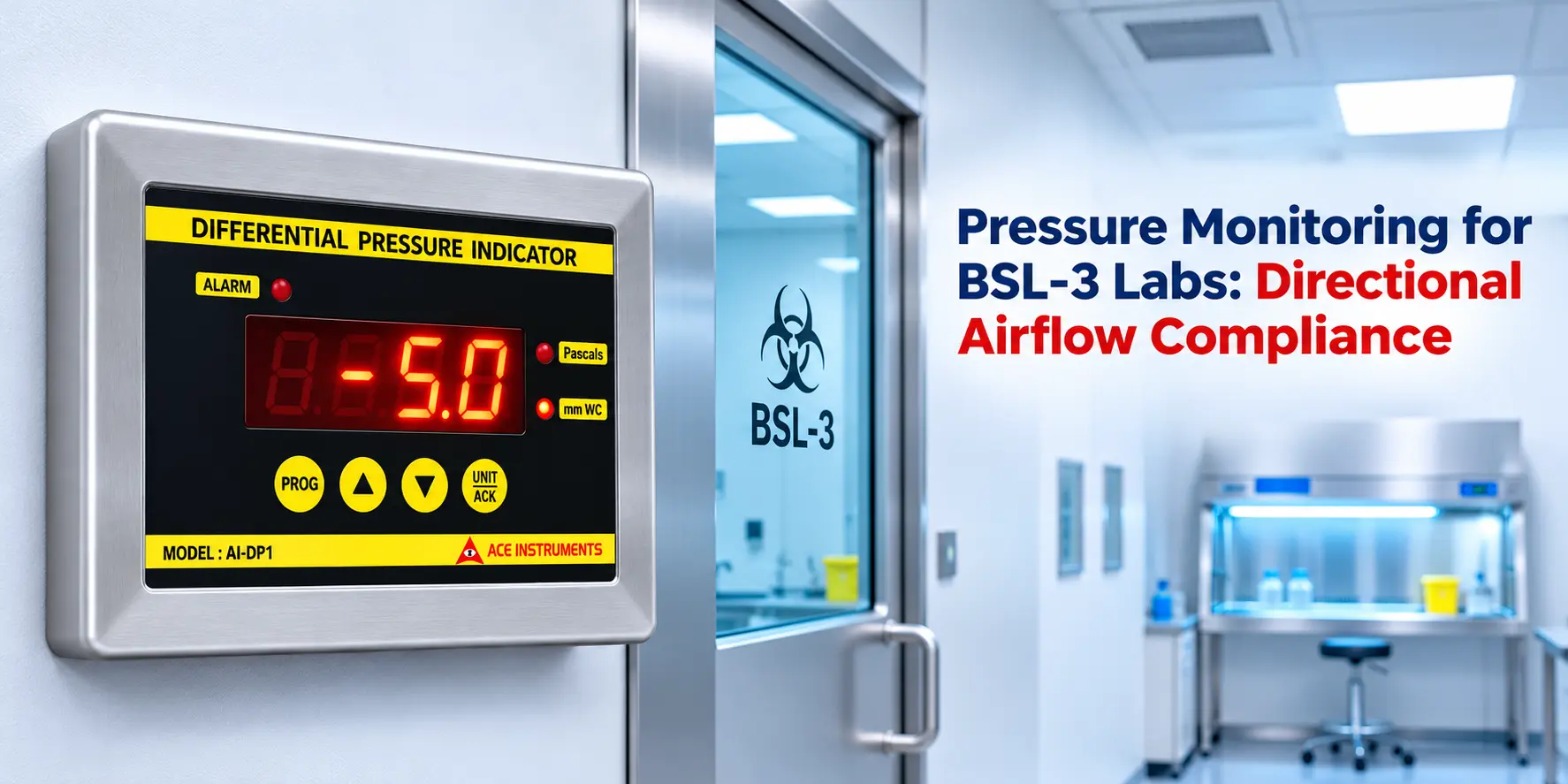
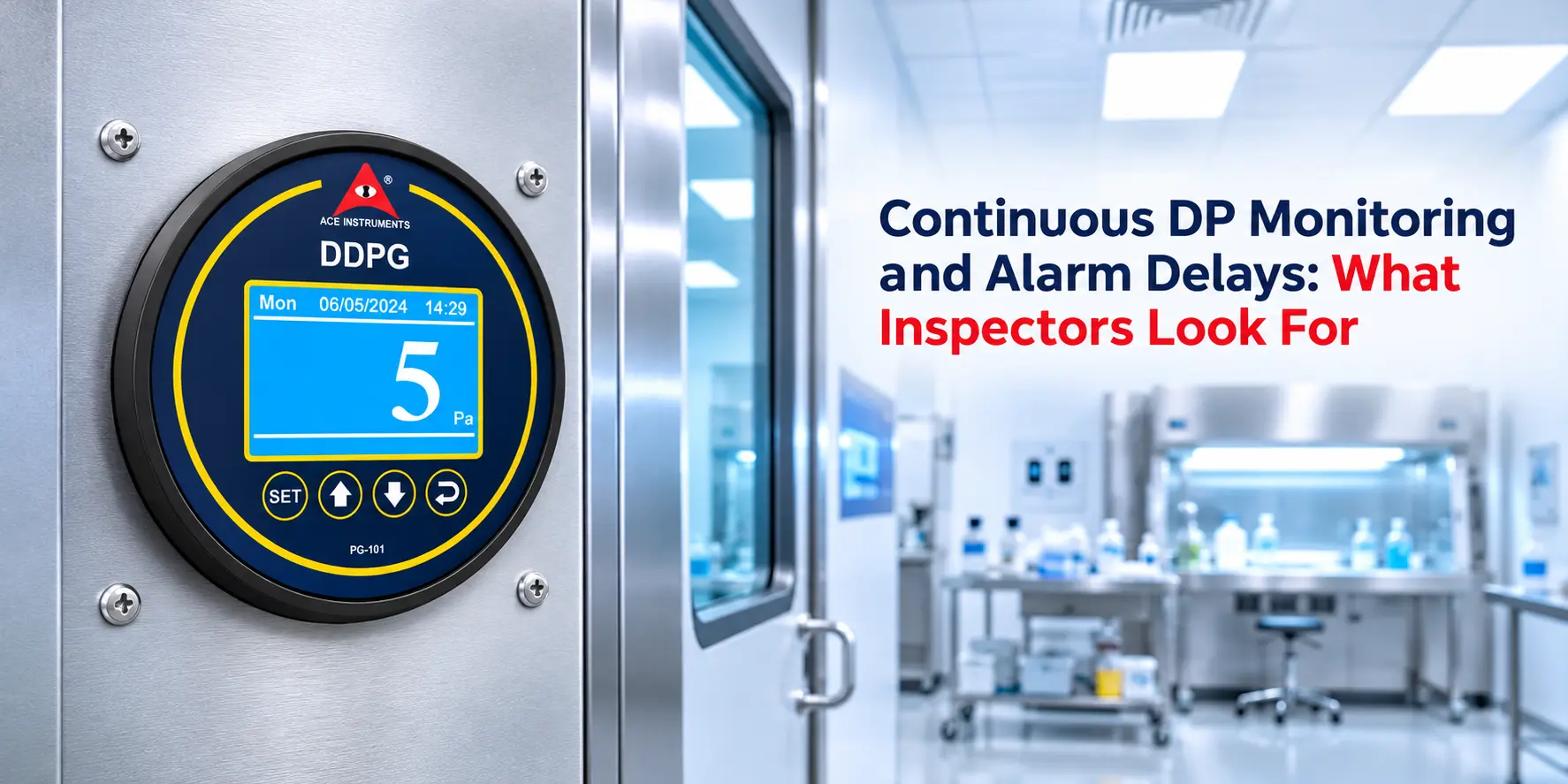
Ace Instruments cleanroom monitors assist users in documenting directional airflow by providing continuous differential pressure measurement, alarm outputs and signals for integration with your BMS. The Differential Pressure Indicators (AI-DP1) and the Digital Differential Pressure Gauge (DDPG TFT) cover the room differential readings.
Ace Instruments has designed and manufactured process instrumentation in Hyderabad since 1991, exports to more than 26 countries, and holds ISO 9001:2015 certification, with CE marking on all products. Contact the Cleanroom Monitors team for datasheets and configuration options.
Stay updated
Know the latest trends in clean room solutions from the Ace Instruments team