
October 16, 2026
The WHO GMP HVAC pressure cascade guidance gives non-sterile plants a practical way to keep dust and cross-contamination where they belong. WHO TRS 1019 Annex 2 is Part 2 of the WHO HVAC guidelines for non-sterile pharmaceutical products, an interpretation document that supports Part 1 (TRS 1010 Annex 8). It is non-binding, and it is not intended as criteria for sterile products or active pharmaceutical ingredients.
What WHO suggests for pressure differentials
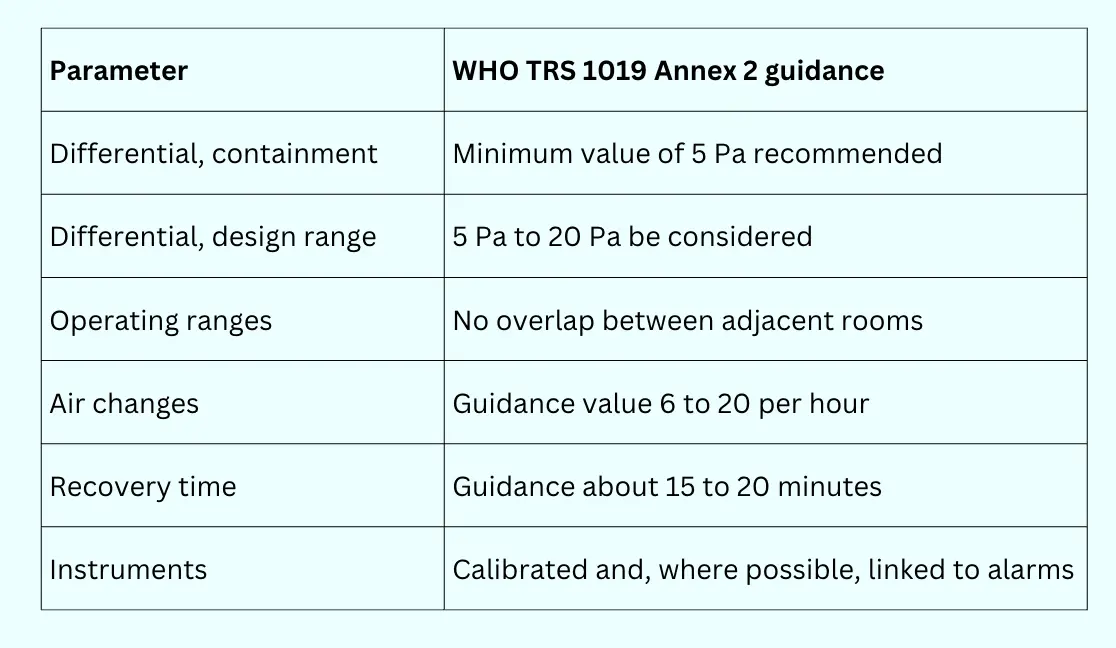
WHO recommends minimum differentials of 5 Pa to support containment, and suggests that differentials between 5 Pa and 20 Pa be considered. The differential should be large enough to prevent flow reversal but not so high that it creates turbulence problems. For comparison, EU GMP Annex 1 gives a 10 Pa guidance value between grades in sterile areas, as set out in Annex 1 pressure differential requirements.
Why ranges must not overlap
WHO’s example is a room allowed to run at 5 to 15 Pa next to a room allowed at 15 to 30 Pa. At the extremes both rooms sit at the same pressure and the cascade fails. The same logic covers instrument tolerance: the combined error of the measuring instruments should not allow a reversal to go undetected, which can be handled by setting limits that never overlap or by reading from a common reference point such as the corridor outside a suite.
For a plant upgrading older HVAC, this is the most useful rule in the document, because it is testable. Write down the low and high operating limit for every room, line them up side by side, and check that each room's low limit clears its neighbour's high limit. When a room still drifts through its range, the cause is often upstream in the air handling, as described in duct static pressure and room pressure cascades.
Airlock types and clean corridors
WHO describes three airlock arrangements, which behave differently for containment.
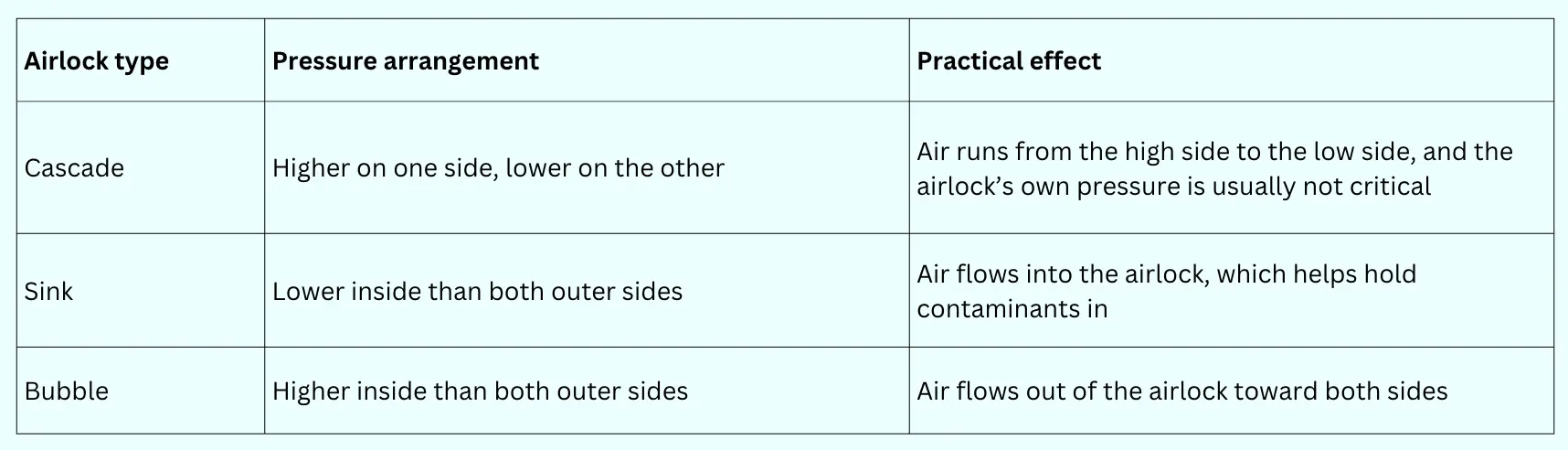
For oral solid dosage areas WHO also describes a clean corridor concept, with higher pressure in the corridor than in production rooms and airlocks, to contain dust generated inside the rooms. WHO also says contamination risks should be controlled especially for potent contaminants, and the air handling for those areas is covered in dedicated AHUs for potent and cytotoxic areas. WHO notes that door gaps, doors opening into low pressure areas and sliding doors all change the real differential, and that interlocks can prevent more than one door opening at once.
Monitoring and shutdown
WHO expects HVAC performance to be monitored against defined limits and says automated monitoring systems that count as GxP systems should be validated, including access, limit setting, alarm acknowledgement and audit trails. It also advises that if AHUs are switched off overnight or at weekends, the decision, risk assessment, procedures and start-up sequence should be documented. Pressure records across those restarts are good evidence. Where the sensors go in the air handling unit is covered in which duct sensors go where, and how monitoring differs between full fresh air and recirculation systems is in fresh air vs recirculation AHU monitoring.
Saudi Arabia's regulator publishes its own requirements, which are covered in SFDA cleanroom monitoring requirements.
Field note
Illustrative scenario: two adjacent rooms are allowed ranges of 5 to 15 Pa and 15 to 30 Pa, and on a warm afternoon both read 15 Pa. Rewriting the limits so the ranges no longer overlap, as WHO advises, removes the reversal risk without changing any equipment.
Frequently asked questions
1. What pressure differential does WHO suggest for non-sterile pharmaceutical plants?
WHO TRS 1019 Annex 2 suggests that differentials between 5 Pa and 20 Pa be considered, with a recommended minimum of 5 Pa to support containment.
2. Does WHO TRS 1019 Annex 2 apply to sterile products?
No. The document says it is not intended as criteria for sterile products or active pharmaceutical ingredients, which are covered by separate sterile manufacturing guidance.
3. Why must pressure ranges not overlap between rooms?
If adjacent rooms are allowed to operate in overlapping ranges, both can sit at the same pressure at the extremes and airflow can reverse. Operating limits should be set so the ranges never overlap.
4. Does WHO expect pressure monitoring to be alarmed?
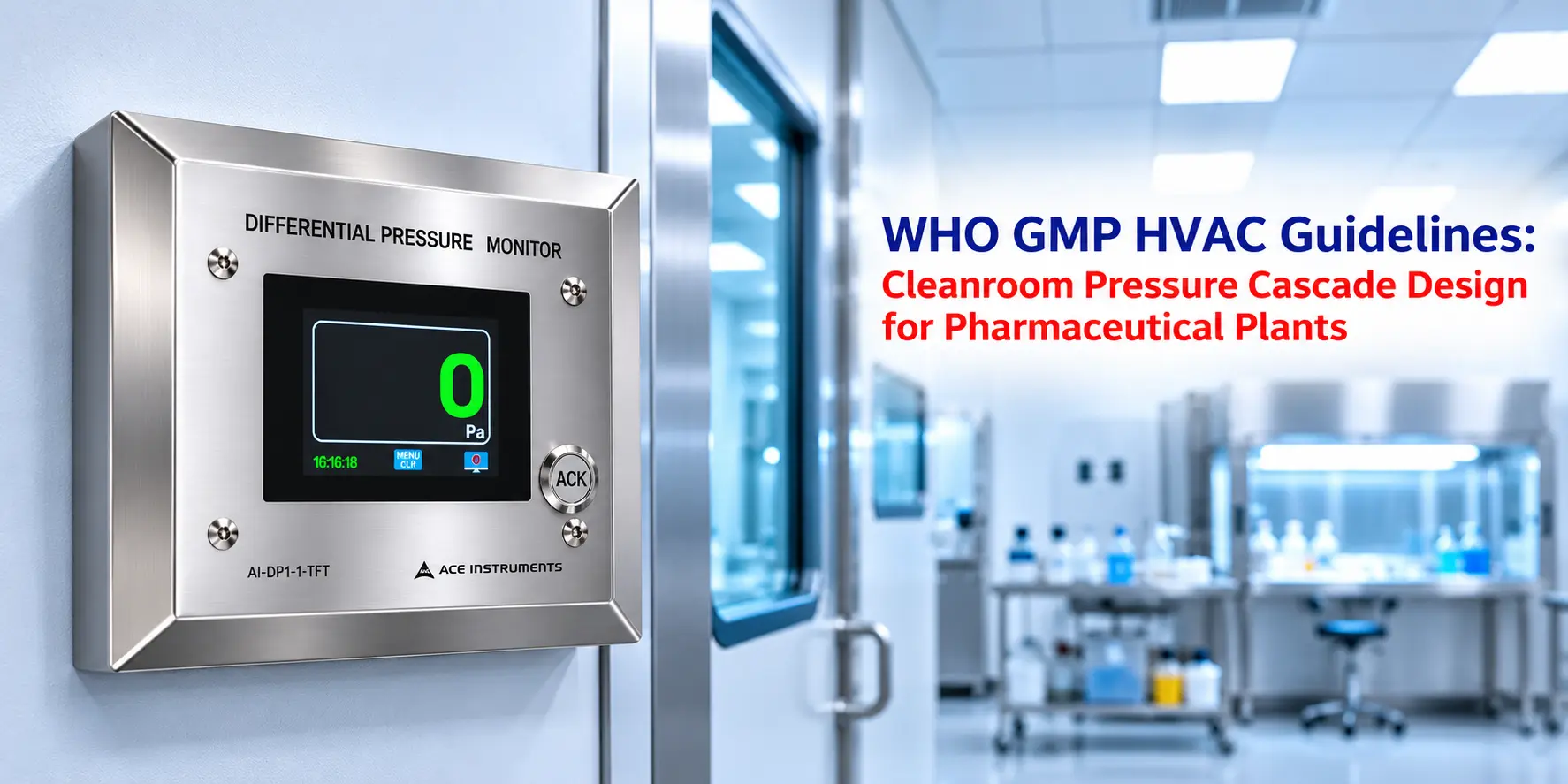
WHO says pressure control and monitoring devices should be calibrated and, where possible, linked to an alarm system set to the determined levels. Automated systems treated as GxP systems should be validated.
Why engineers specify Ace Instruments
Ace Instruments cleanroom monitors assist users in complying by providing continuous differential pressure measurement, alarm outputs and signals for integration with your BMS. The differential pressure monitor with colour TFT screen covers the room differentials, and the duct mounted humidity and temperature transmitter covers AHU supply air readings.
Ace Instruments has designed and manufactured process instrumentation in Hyderabad since 1991, exports to more than 26 countries, and holds ISO 9001:2015 certification, with CE marking on all products. Contact the Cleanroom Monitors team for datasheets and configuration options.
Stay updated
Know the latest trends in clean room solutions from the Ace Instruments team