November 12, 2026
Cleanroom temperature limits in GMP are mostly set by the site, not by a number in the regulation. EU GMP Annex 1 links temperature to the product, the process and the comfort of gowned operators, and FDA's 21 CFR 211 asks for temperature controls in aseptic processing without naming a range. That leaves quality teams to justify their own setpoints, alert limits and alarms, and to prove with a continuous record that the room stayed inside them.
What the regulations say about temperature
ISPE's review of EU and US requirements describes the regulatory text as surprisingly vague. EU GMP Chapter 3 says temperature, humidity and ventilation should be appropriate and should not adversely affect products or equipment. The earlier edition of Annex 1 that ISPE quotes says temperature and relative humidity depend on the product and the operations, should not interfere with the defined cleanliness standard, and should not be uncomfortably high because of the garments worn. The 2022 revision words this differently, so check the current text before quoting it.
In the US, 21 CFR 211.42(c)(10)(ii) lists temperature and humidity controls as part of aseptic processing, and 21 CFR 211.46(b) calls for equipment to control air pressure, microorganisms, dust, humidity and temperature where appropriate.
Why gowning sets the temperature
When a product or process has no temperature requirement, the setpoint defaults to what keeps gowned staff comfortable and limits shedding. ISPE suggests a setpoint around 22 °C for street clothes, around 20 °C for ISO 8 and closer to 17 to 18 °C for ISO 7, because higher grades mean more gowning layers. Temperature also affects growth: ISPE notes that a rise from 20 °C to 25 °C can roughly double the rate of bacterial multiplication.
These are ISPE's suggested design conditions for initial settings while operating data is gathered. They are not limits from Annex 1 or FDA, and a product or process requirement overrides them.
Setting alert limits and delays
ISPE advises setting alarm levels after observing how each system varies, with a short delay so brief air movements or signal noise do not cause nuisance alarms. Alert alarms sit close to the operating limits to give early warning, and the alert range should allow for instrument error, which is why sensor accuracy matters. For the sensor side, see Pt1000 Class A Sensors: IEC 60751 and GMP Accuracy. Where design conditions are comfort based, ISPE notes that short excursions are often not a quality concern. That does not apply where a product limit exists.
Field note
Illustrative scenario: an inspector asks where a plant's 22 °C set point comes from. The plant shows its gowning assessment and product data instead of a copied number, and the monitoring record shows the room held within the limits it chose.
Frequently asked questions
1. What temperature should a GMP cleanroom be kept at?
There is no single value in the regulations. The setpoint follows the product, the process and the gowning level. ISPE suggests starting ranges around 17 to 20 °C for ISO 7 and Grade A or B areas, and 18 to 22 °C for ISO 8, Grade C and Grade D.
2. Does EU GMP Annex 1 give a numeric temperature limit?
The Annex 1 text reviewed by ISPE links temperature and humidity to the product and operations and does not give a fixed figure. Check the 2022 wording in your own copy.
3. Why are higher grade cleanrooms kept cooler?
Higher grades need more gowning layers, so lower temperatures keep operators comfortable and limit sweating and shedding.
4. How should cleanroom temperature alarms be set?
Base the limits on observed system variability, set alert limits close to the operating limits, allow for instrument error, and use a short delay so brief air movements do not cause nuisance alarms.
Why engineers specify Ace Instruments
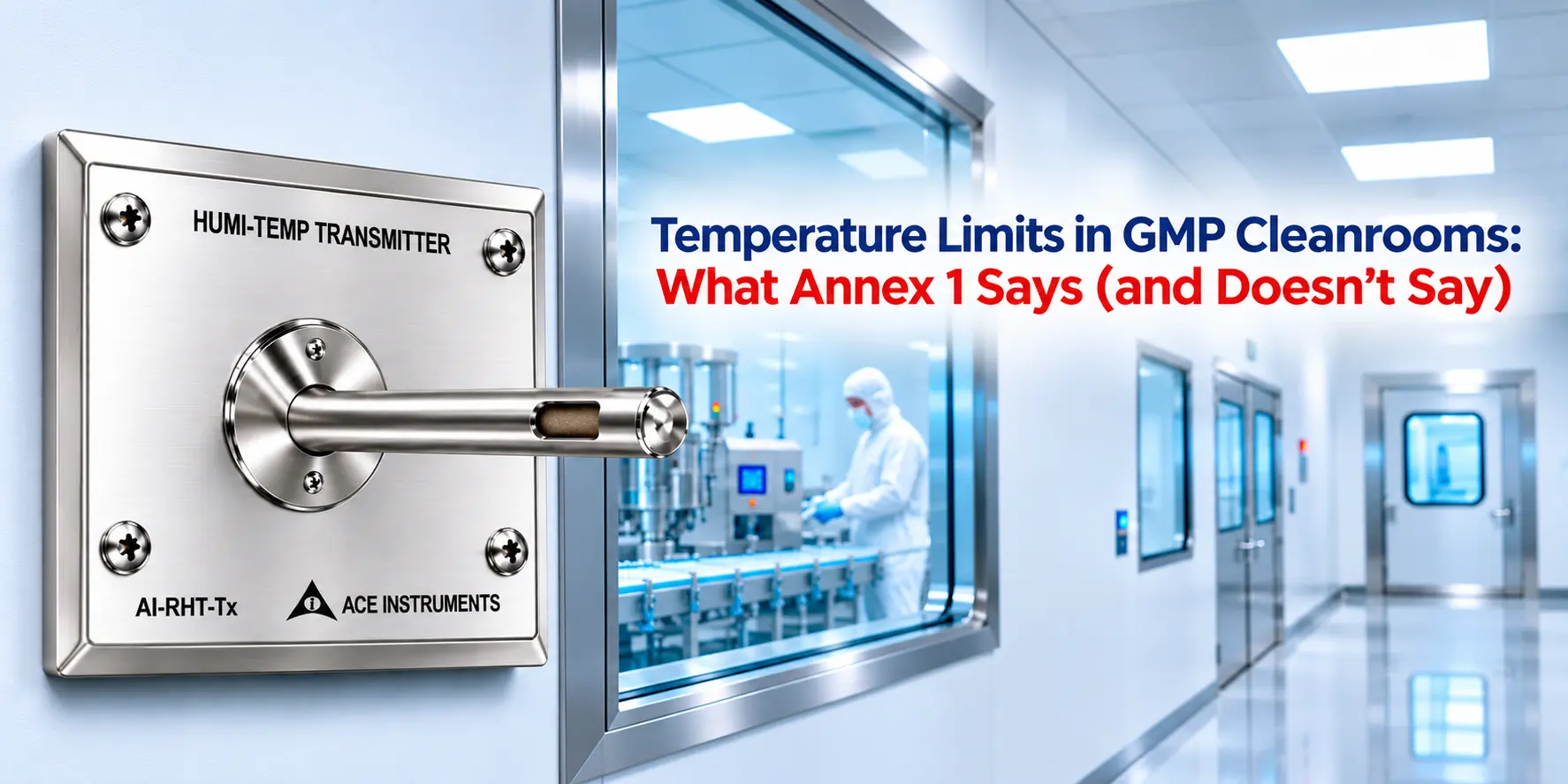
Ace Instruments cleanroom monitors assist users in complying with their own temperature limits by providing continuous measurement, configurable alarms and signals for integration with your BMS. See the RHT transmitter and the humidity and temperature monitor. Temperature is most useful beside pressure, so see Annex 1 pressure differential requirements and Temperature Mapping vs Continuous Monitoring: WHO TRS 961. The duct mounted temperature transmitter completes the monitoring set.
Ace Instruments has designed and manufactured process instrumentation in Hyderabad since 1991, exports to more than 26 countries, and holds ISO 9001:2015 certification, with CE marking on all products. Contact the Cleanroom Monitors team for datasheets and configuration options.
Stay updated
Know the latest trends in clean room solutions from the Ace Instruments team